Character Animation for Agents
Rig and animate any 3D model from a sentence. SkinTokens (ACM TOG 2026) predicts the skeleton and skin weights, the rig becomes a reusable asset on this Space, and UniMate (SIGGRAPH Asia 2026) generates the motion from text, then refines it: in-betweening, joint editing, multi-prompt expansion. One synchronous call on a ZeroGPU slice, or each stage on its own.
Guide /llms.txtOpenAPI /openapi.jsonSwagger /docsMCP /gradio_api/mcp/Gradio schema /gradio_api/infoService /api
Give this to your agent
Read https://townbox-character-animation-for-agents.hf.space/llms.txt and use this service to <WHAT_TO_RIG_OR_ANIMATE_AND_WHAT_TO_DO_WITH_THE_FILES>. Use my configured Hugging Face token if available.
Connect over MCP
https://townbox-character-animation-for-agents.hf.space/gradio_api/mcp/ · schema /gradio_api/mcp/schemaanimate_mesh (mesh_url / example / rig_job_id / asset, prompt or prompts, rig and motion options) · rig · prepare_asset (rig_job_id / mesh_url / asset_id, labels, facing) · animate · inbetween · edit_joints · expand · list_assets · get_asset · list_examples · get_result · view_rig, view_animation, view_asset (return PNGs) · service_info · guideclaude mcp add --transport http character-animation https://townbox-character-animation-for-agents.hf.space/gradio_api/mcp/ --header "Authorization: Bearer $HF_TOKEN"{
"mcpServers": {
"character-animation": {
"url": "https://townbox-character-animation-for-agents.hf.space/gradio_api/mcp/",
"headers": { "Authorization": "Bearer <HF_TOKEN>" }
}
}
}First call: animate_mesh with a model URL (or an example id) and a prompt that starts with “An object”; the result carries the rig, the asset and the motion with every file URL. Its asset id is reusable in animate and expand, its animation job id is the reference for inbetween and edit_joints. Signed in on the Hub, the Space's Agents menu also adds it to your Hugging Face MCP tools.
How the pieces fit
POST /api/rig · MCP rig → r_ job: rigged.glb, rig.json, skin.npz, previewrig_preprocess runs here: Blender import, joint labels from one anatomical vocabulary, the facing pair, the canonical T-pose and a canonical GLB. Any rigged file works, not only rigs made here. A preview and review flags show what the motion model is told; labels and facing can be corrected. 5-30 s of CPU.POST /api/assets · MCP prepare_asset → u_ asset, reusablePOST /api/animate, /api/inbetween, /api/edit, /api/expand → a_ job: animation.glb, motion.npy, joints.json, previewPOST /api/animate_mesh (MCP animate_mesh) runs all three in one request and returns a p_ result with the three stages and a flat map of file URLs; rig_job_id or asset in its body skip the stages already done. Results are kept 24 h, assets until the Space restarts.
Examples generated by this Space
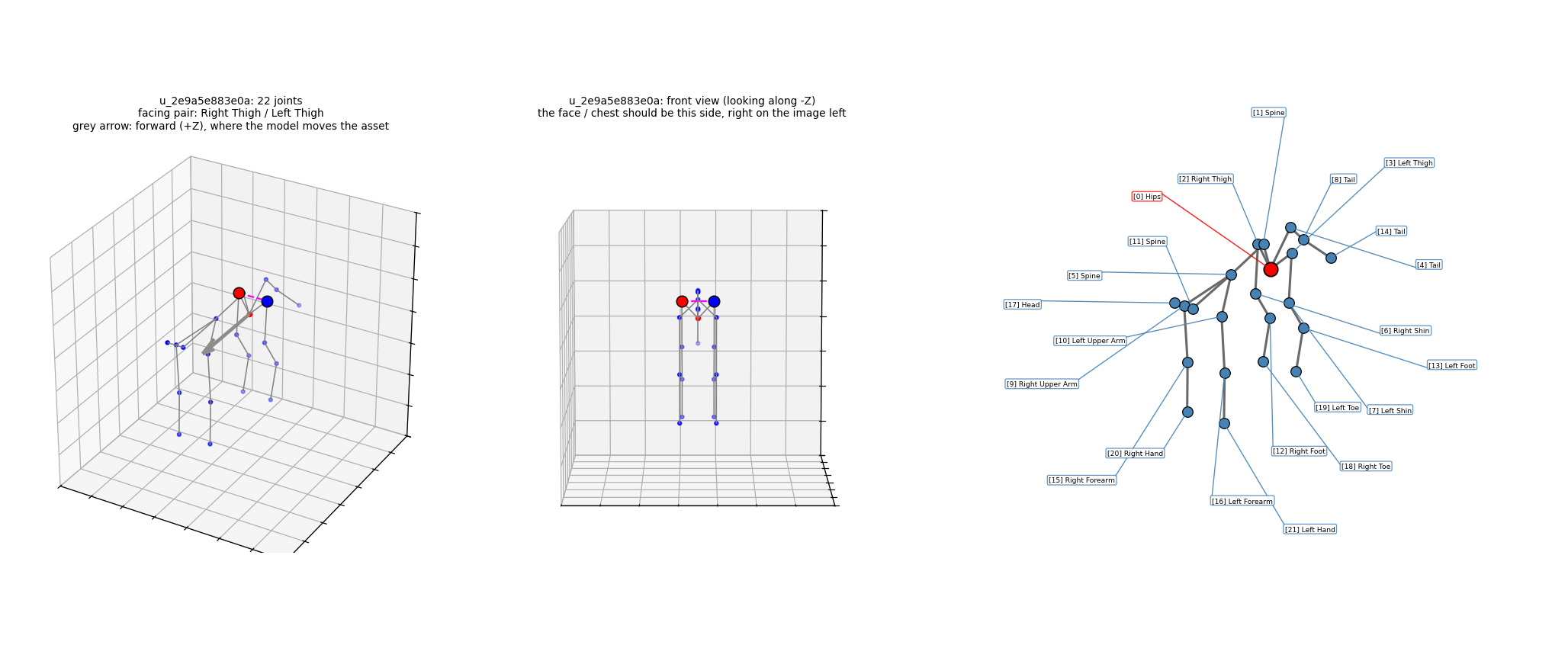
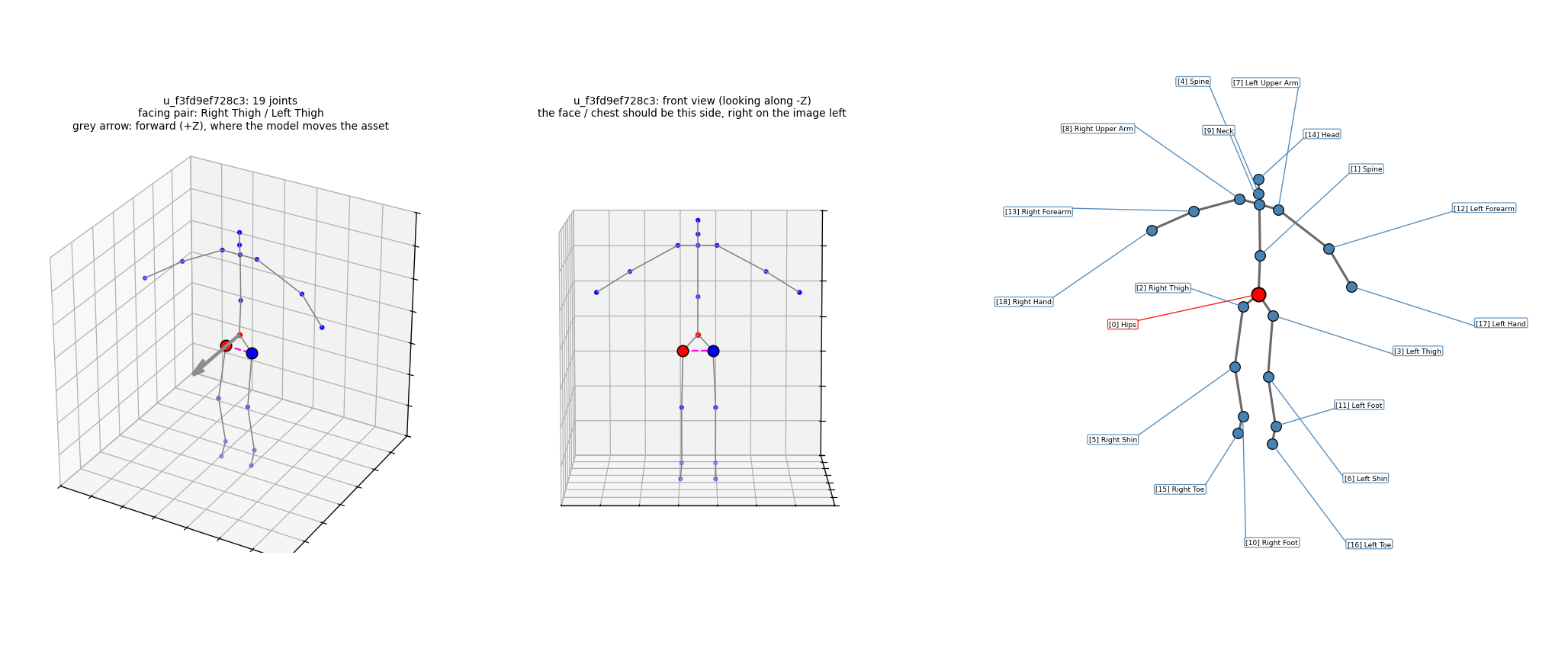
6 real outputs of this API, produced on 2026-11-05 on the ZeroGPU slice: 4 by POST /api/animate_mesh (each model rigged by SkinTokens, prepared as an asset, animated by UniMate, in one request), then one /api/expand chain and one /api/edit on those assets. Each picture is an animated GIF of the generated motion, rendered from the animation GLB the API returned (15 fps, camera fixed on the whole path); click it to load the 3D mesh itself (drag to orbit). Under each: the rig preview the API returns (mesh with the predicted skeleton) and the asset preview (what the motion model is told: canonical T-pose, facing pair, labels), or the skeleton motion itself for the expansion and the edit. The seeds reproduce them; the API always generates fresh results. Machine-readable list: /api/examples.

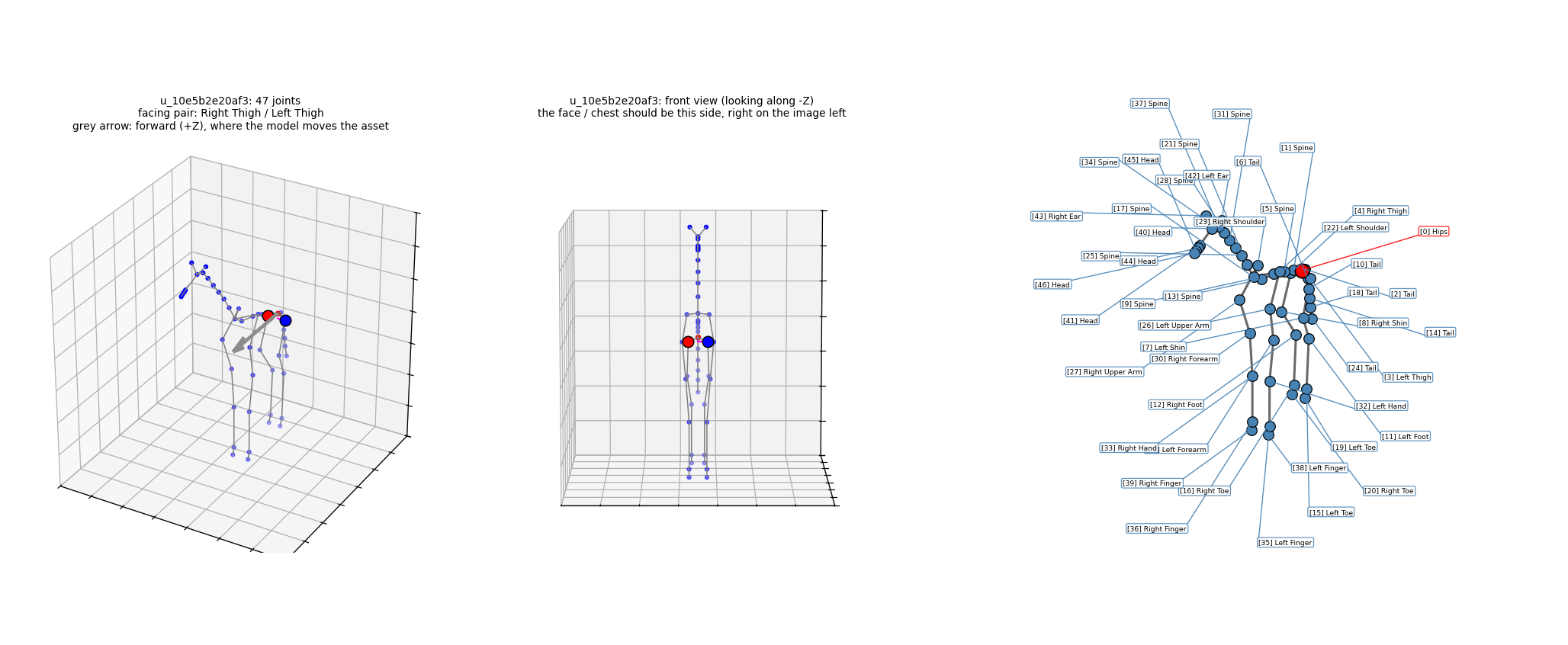
POST /api/animate_mesh: SkinTokens rig of 47 joints (15.8 s GPU, 10 beams, seed 7, textures kept) · asset prepared in 5.8 s (facing Right Thigh / Left Thigh, 0 flagged) · UniMate motion seed 7, 6.8 s GPU · root travel 0.78 · 34 s in all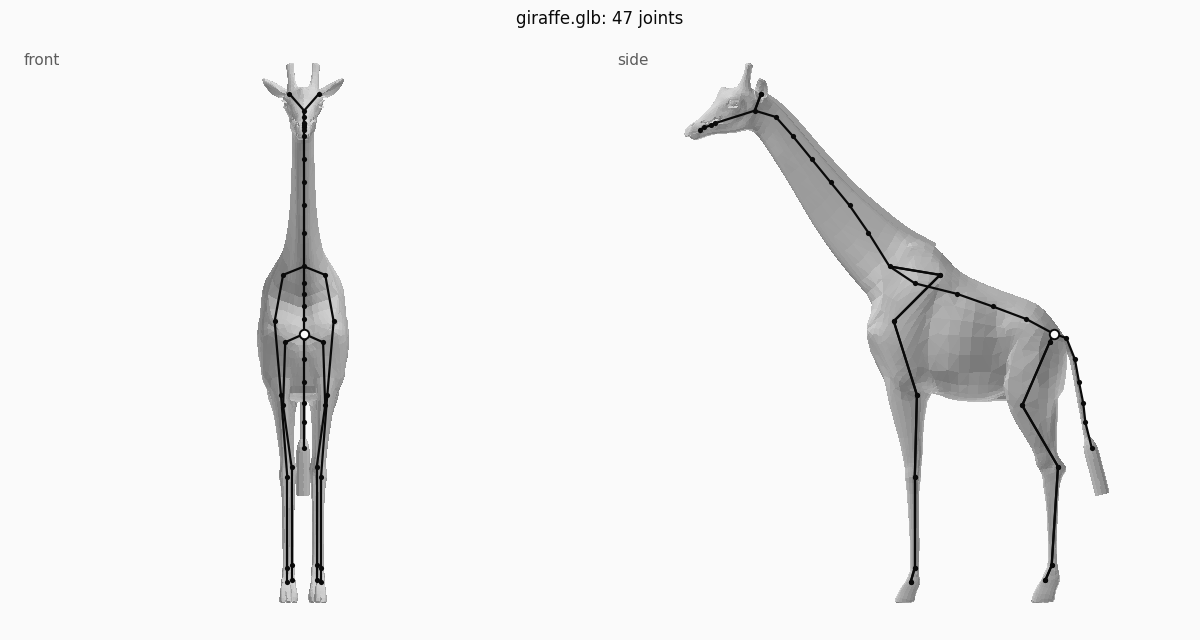


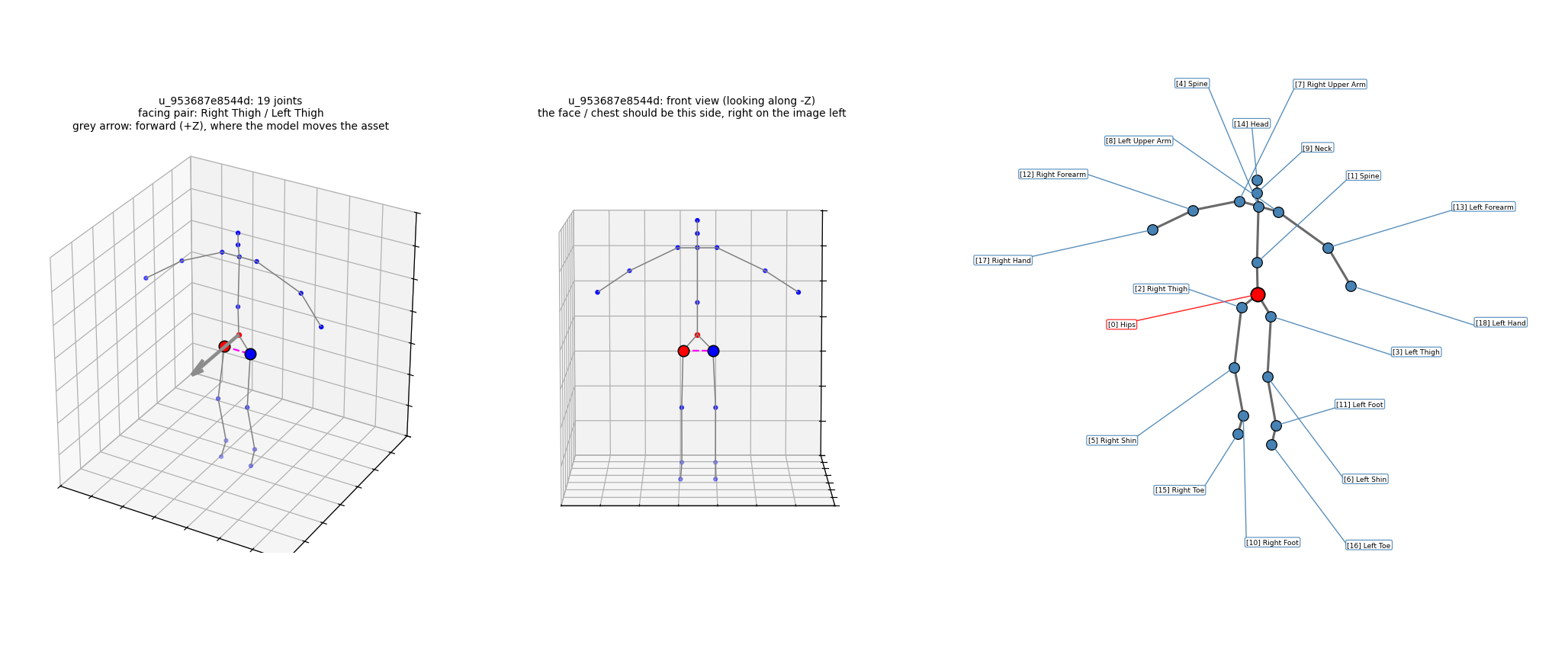
POST /api/animate_mesh: SkinTokens rig of 19 joints (5.5 s GPU, 10 beams, seed 7) · asset prepared in 3.1 s (facing Right Thigh / Left Thigh, 0 flagged) · UniMate motion seed 7, 8.2 s GPU · root travel 0.05 · 20 s in all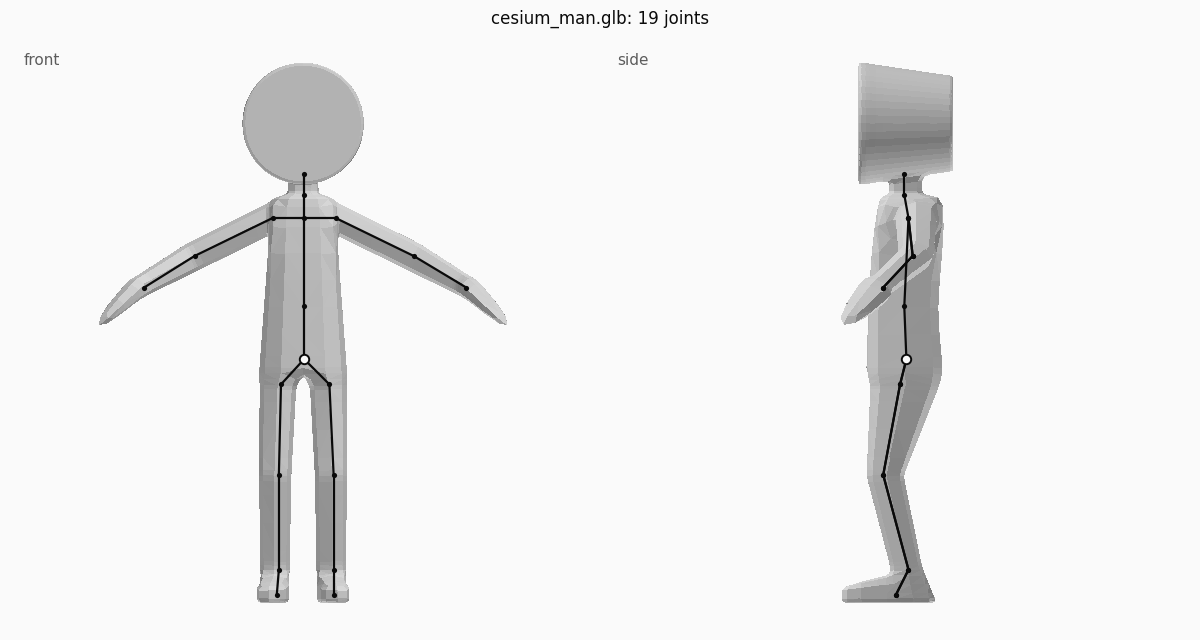


POST /api/animate_mesh: SkinTokens rig of 22 joints (6.5 s GPU, 10 beams, seed 7) · asset prepared in 2.7 s (facing Right Thigh / Left Thigh, 0 flagged) · UniMate motion seed 5, 7.5 s GPU · root travel 1.33 · 20 s in all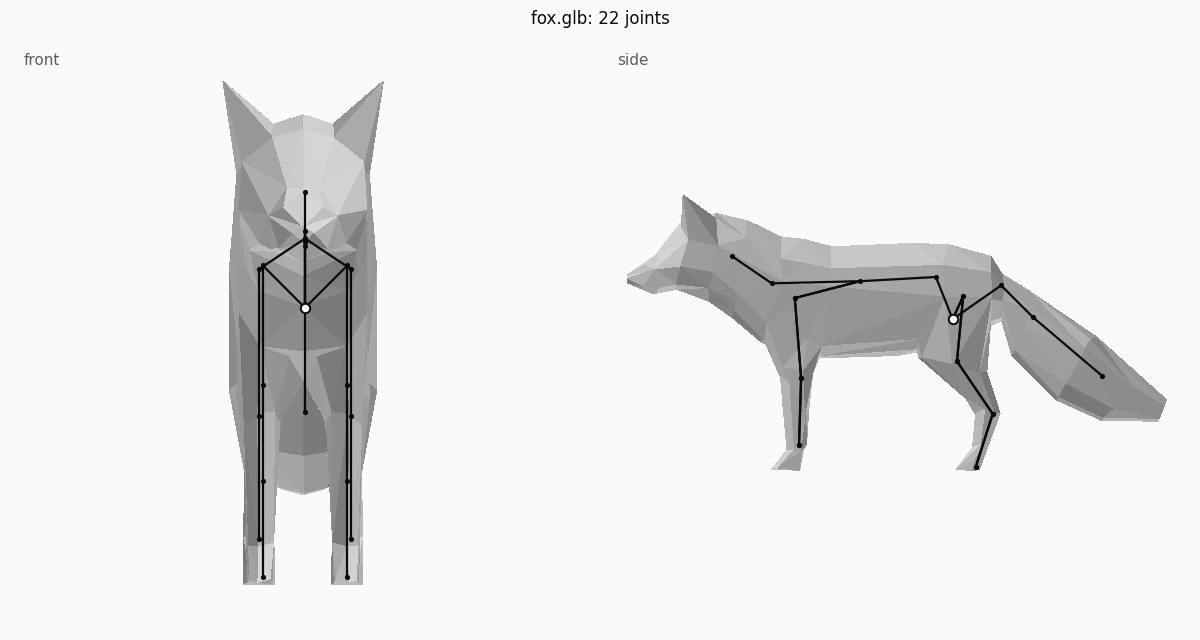


POST /api/animate_mesh: SkinTokens rig of 19 joints (5.5 s GPU, 10 beams, seed 7) · asset prepared in 2.8 s (facing Right Thigh / Left Thigh, 0 flagged) · UniMate motion seed 3, 6.8 s GPU · root travel 0.07 · 25 s in all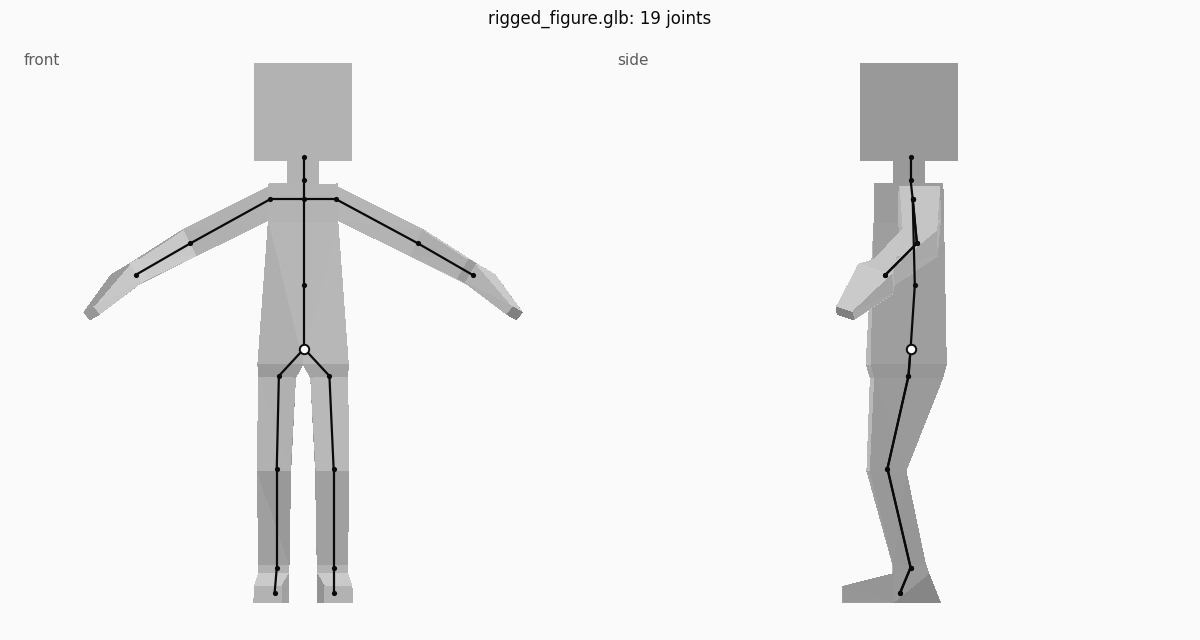


POST /api/expand, 3 prompts, overlap 10 · seed 7 · 12.2 s GPU · root travel 1.00 · segments at frames 0, 50, 100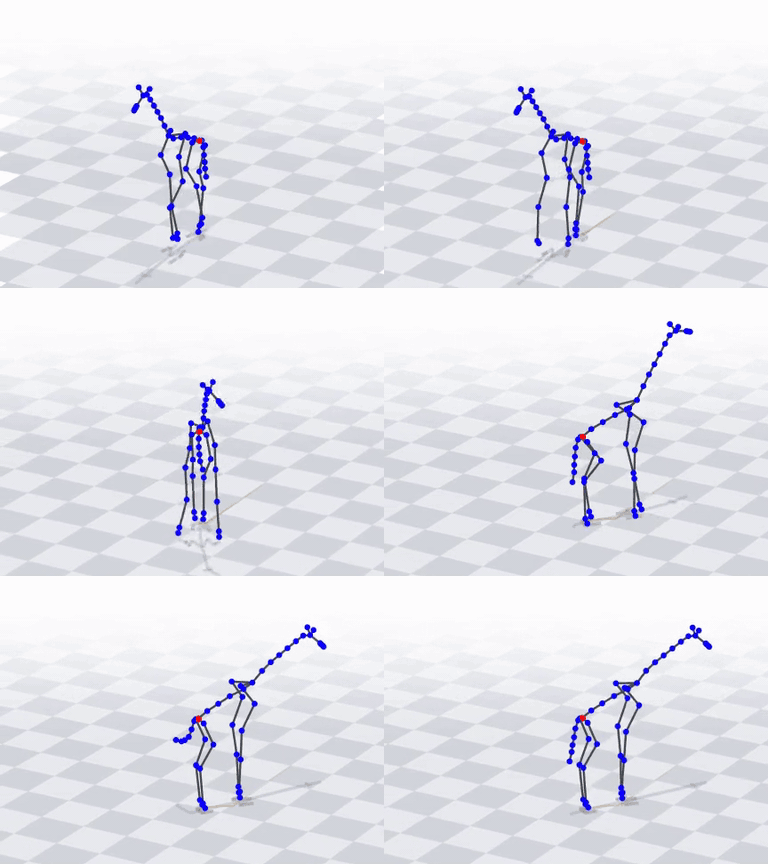


POST /api/edit, keep_joints = Left Foot, Left Shin, Left Thigh, Left Toe, Right Foot, Right Shin, Right Thigh, Right Toe (8 joints) · seed 4 · 5.6 s GPU · 11 joints regenerated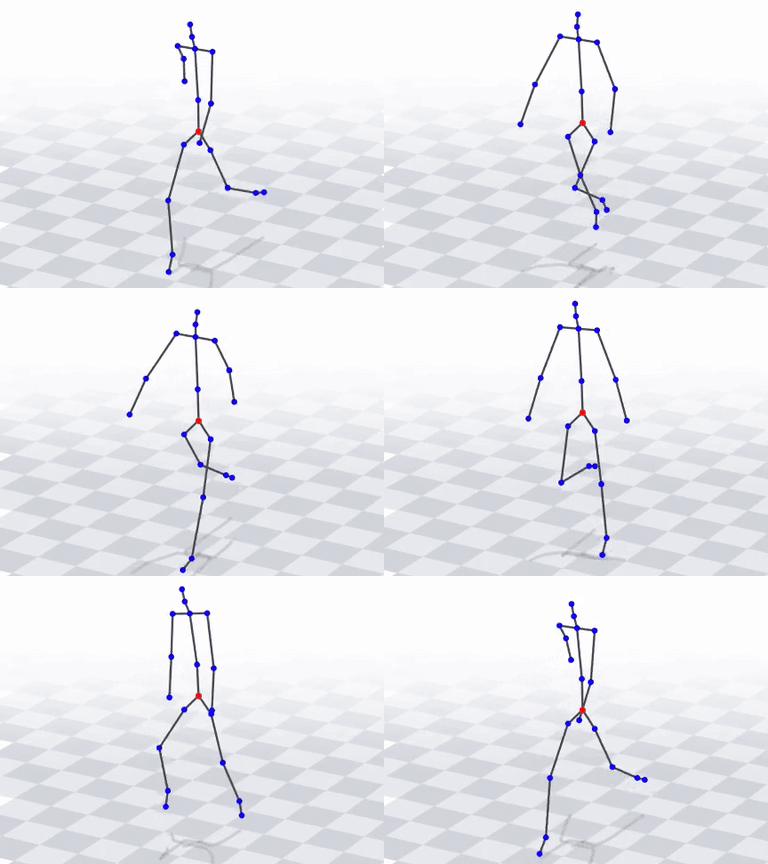

Bundled example assets
Meshes: the example ids of POST /api/rig and /api/animate_mesh. Each link opens the file in the Hugging Face file viewer (3D preview, history, download from there) rather than downloading it.
giraffefoxcesium_manrigged_figureSkeletons: prepared assets, the asset ids of POST /api/animate and /api/expand; they need no rigging.
unitree_go2eaglesharkFor programs: /api/examples lists the same inputs with a mesh_url per mesh, and GET /api/assets/{id}/rest.glb serves a skeleton’s canonical GLB. The folders on the Hub: examples/ (also holds the showcase outputs above) and assets/examples/ (with each skeleton’s annotation.json, cond.npy and preview).
Quick start
BASE=https://townbox-character-animation-for-agents.hf.space
# one call: mesh -> rig -> asset -> animated GLB (about a minute; GPU time goes to your ZeroGPU quota)
curl -s -X POST $BASE/api/animate_mesh -H "Authorization: Bearer $HF_TOKEN" -H 'content-type: application/json' \
  -d '{"example": "giraffe", "prompt": "An object walks forward.", "seed": 7}'
# your own model: the file as the body, the prompt as a query parameter
curl -s -X POST "$BASE/api/animate_mesh?filename=robot.glb&prompt=An%20object%20walks%20forward." \
  -H "Authorization: Bearer $HF_TOKEN" -H 'content-type: application/octet-stream' --data-binary @robot.glb
# download the animated, rigged mesh (urls.animation_glb of the result)
curl -s -H "Authorization: Bearer $HF_TOKEN" -o walk.glb "$BASE/api/jobs/<a_job_id>/files/sample0_animation.glb"

# the stages, one call each
curl -s -X POST $BASE/api/rig -H "Authorization: Bearer $HF_TOKEN" -H 'content-type: application/json' -d '{"example": "fox", "seed": 7}'
curl -s -X POST $BASE/api/assets -H "Authorization: Bearer $HF_TOKEN" -H 'content-type: application/json' -d '{"rig_job_id": "<r_job_id>"}'
curl -s -X POST $BASE/api/animate -H "Authorization: Bearer $HF_TOKEN" -H 'content-type: application/json' \
  -d '{"asset": "<u_asset_id>", "prompt": "An object jumps in place.", "num_samples": 2}'
# keep what you like, regenerate the rest (reference = an a_ job), or chain prompts
curl -s -X POST $BASE/api/edit -H "Authorization: Bearer $HF_TOKEN" -H 'content-type: application/json' \
  -d '{"reference_job_id": "<a_job_id>", "keep_joints": "Left Thigh, Right Thigh, Left Shin, Right Shin", "prompt": "An object waves its arms."}'
curl -s -X POST $BASE/api/expand -H "Authorization: Bearer $HF_TOKEN" -H 'content-type: application/json' \
  -d '{"asset": "<u_asset_id>", "prompts": ["An object walks forward.", "An object turns around.", "An object sits down."]}'
Endpoints
POST /api/animate_mesh?filename=, multipart file, JSON {example} / {mesh_url}) or {rig_job_id} / {asset}, plus prompt (or prompts) and any rig, asset and motion option. Returns the three stages, every file URL and the follow-up calls.POST /api/rignum_beams, seed, keep_skeleton, preserve_original, postprocess, influences, sampling parameters.POST /api/assets{rig_job_id}, a rigged glb/gltf/fbx (body, multipart or mesh_url), a zipped rig_preprocess output, or {asset_id} with corrections (labels, face_right, face_left, body_axis, rest_rotation, annotation).GET /api/assets, /api/assets/{id}rest.glb, files/preview.png, files/annotation.json, annotation.POST /api/animate{asset, prompt, num_samples?, cfg_scale?, seed?, preview?}. Returns the result with a URL per output file and ready-made next bodies for the modes below.POST /api/inbetween{reference_job_id, reference_sample?, reference_start?, keep_frames?, prompt, …}. Kept frames stay, the others are regenerated.POST /api/edit{reference_job_id, reference_sample?, reference_start?, keep_joints, prompt, …}. Kept joints stay, the others are regenerated.POST /api/expand{asset, prompts[], overlap?, …}. One long motion from several prompts; num_samples × prompts ≤ 8 per call.GET /api/jobs/{job_id}r_, a_ or p_. Files: /api/jobs/{job_id}/files/{name}.GET /api/examplesGET /api/identityGET /api, /api/health, /api/gpu_checkParameters
prompt, promptsprompts: 2 to 6 captions for a chained motion.num_beams, seed / rig_seedanimate_mesh the rig's seed is rig_seed.keep_skeleton, preserve_originalpostprocess, influenceslabels, face_right, face_left{joint name: label} from the anatomical vocabulary; the two joints (the character's own right and left) that define its facing. body_axis marks a head / tail pair; rest_rotation (“x180”, “x90,y180”) stands up a lying or upside-down rest pose.num_samples, cfg_scale, seedreference_job_id, reference_sample, reference_startkeep_frames, keep_joints"0,-1"); joint names or labels held at the reference (case-insensitive; a label selects every joint carrying it).overlap, previewOutputs
bone_0 is the root) + skin weights; joint names, parents, rest positions, skin statistics; the full weights.unimate.inference.sample writes; world joint positions per frame with names, labels and parents.Models and provenance
Skin Tokens: A Learned Compact Representation for Unified Autoregressive Rigging. Jia-peng Zhang, Cheng-Feng Pu, Meng-Hao Guo, Yan-Pei Cao, Shi-Min Hu. ACM Transactions on Graphics 2026. arXiv 2602.04805 · code (MIT) · weights (MIT) · authors' Space. This service runs the released checkpoint grpo_1400.ckpt (TokenRig, 595M parameters) through the authors' own inference code, vendored from their Space at revision 1f4445ba; Blender 4.5 reads the input and writes the rigged GLB. The same engine as SkinTokens for Agents.
UniMate: One Unified Model to Animate Diverse Skeletons. Linzhan Mou, Jiahui Lei, Zhiyang Dou, Chenyue Cai, Chaoyue Song, Adam Finkelstein, Szymon Rusinkiewicz. SIGGRAPH Asia 2026. arXiv 2609.05415 · project page · code (MIT) · checkpoints (CC BY-NC 4.0). This service runs unimate_uniml3d_f60_v3 step 150000 (EMA weights, 74M-parameter flow-matching transformer, 50 ODE steps) with the frozen google/flan-t5-base text encoder through the repository's own inference code at commit b78c7807, and prepares assets with the repository's own data_process.rig_preprocess pipeline (offline rule annotation, no LLM). The same engine as UniMate for Agents. The animated GLB comes from a Blender-free glTF baker checked against Blender's importer (1e-5).
SkinTokens code and weights are MIT; UniMate code is MIT and its weights are for non-commercial research use (CC BY-NC 4.0; the training data keep their own terms). The bundled example assets keep their licenses (listed above and by /api/examples). The UniMate project page's 3D showcase is access-controlled and is not used; every output of this service is generated live. Details in PROVENANCE.md.
Limitations
SkinTokens names joints bone_i, builds a single-rooted tree, occasionally stops early (the service retries once with the next seed) and gives arbitrary skeletons to shapes that are not characters. The labels of such a rig come from the rest-pose geometry (symmetry, limbs, floor, trunk, head, tail), so unusual bodies or a lying / upside-down rest pose get placeholder labels or no facing pair: the asset preview and the flags show it, labels, face_right / face_left and rest_rotation correct it; at most 71 joints. UniMate has no contact model (feet can slide or hover), rare skeletons and motions can come out static, jittery or off-prompt, and it generates 60 frames per prompt (longer through expansion) as rotations only. Ask for several samples, try a few phrasings, raise cfg_scale to 5 to 7 when a prompt is ignored.